How to read world energy numbers
The type number starts with a yearly energy total. The total only helps if you know what is inside it.
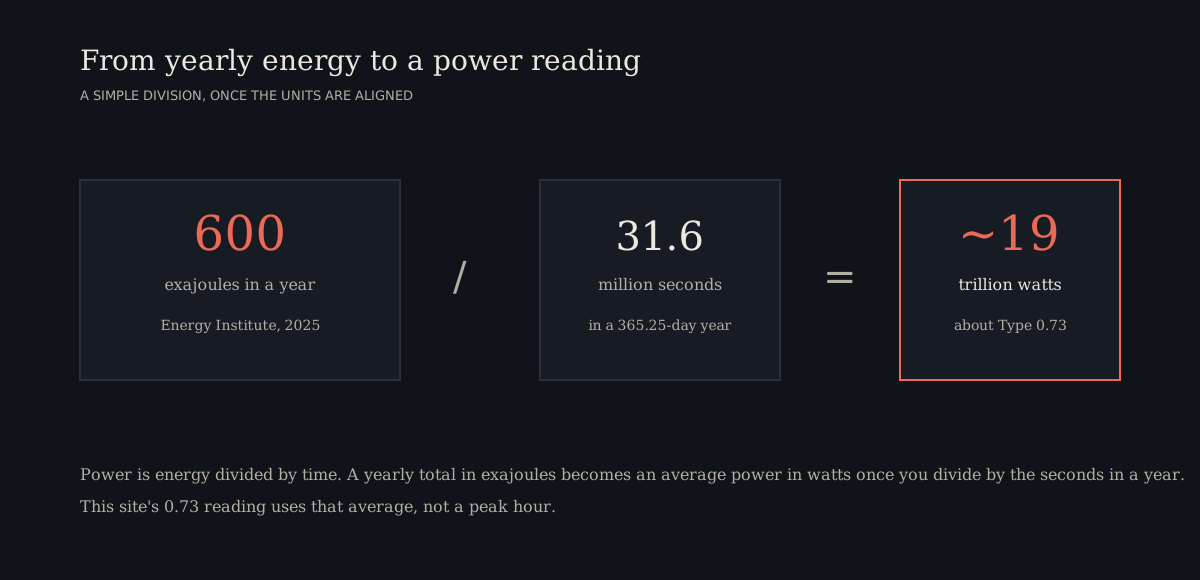
Exajoules, then watts
Energy reports often give a yearly total in exajoules. One exajoule is 10^18 joules. A joule is a unit of energy. A watt is a unit of power, which is energy per second. To turn a yearly total into an average power, divide by the number of seconds in a year, about 31.6 million. That is how 600 exajoules becomes about 19 trillion watts.
The type number uses power, not the yearly total itself, because the Kardashev scale is defined in watts. Both views are useful. The yearly total is what the reports publish. The watts are what the scale wants. Where humanity sits on the scale uses both.
Primary energy is more than electricity
The headline world energy total is usually primary energy. That includes fuels burned for heat and transport, not only the energy that shows up as electricity in a wall socket. Electricity is part of the picture, and it is a growing part, but it is not the whole picture.
If you compare an electricity figure with a primary-energy figure, you will get a confused story. Solar's share of electricity can be 9% while its share of primary energy is lower, because much of the world's energy still goes to heat and transport rather than to power stations. When this site says solar supplies about 9% of the world's electricity, that is an electricity figure, from SolarPower Europe, and should not be read as 9% of all energy.
Conversion losses also hide in these totals, depending on how a report is built. Some methods count the fuel that goes into a power station. Others count the electricity that comes out. Those are different numbers. We cannot settle every accounting debate here. We can refuse to mix them quietly.
Capacity is not the same as energy delivered
Capacity, often given in watts or terawatts, is the nameplate size of a fleet of generators. It is the output they could produce under stated conditions. Energy delivered is what they actually produce over a year. For solar, the sun is not always up and not always unobscured, so energy delivered is lower than you would get by multiplying capacity by every hour of the year.
A rise in installed capacity is still a real fact. It means more collectors have been built. It does not, by itself, tell you the year's energy total, and it does not move the type number until that energy is used. Solar capacity and the mix keeps those two ideas apart.
Growth rates and the log scale
A 1.7% rise in world energy use is a large change in the physical economy. It is a small change on a logarithmic type scale. To move the type by 0.01 you need a rise of about 26%. To move it by 0.1 you need a tenfold rise. The Energy Institute figure for 2025, 600 exajoules, up 1.7%, is a record in the report's terms and a wiggle on the Kardashev scale. Both of those statements can be true at once.
When you read a headline, ask which quantity moved: primary energy, electricity, capacity, or the type number. Ask for the year, the source, and whether you are looking at a total or a share. If a page on this site cites a figure, it should give you a source you can open. The home page and the source list are the starting point.
Common questions
Why not just use electricity figures for the type number?
Because a civilization's energy use includes heat and transport, not only electricity. A type based only on electricity would understate the power being used and would jump in a misleading way as more work is electrified.
Is 600 exajoules a precise physical constant?
No. It is a published annual total from the Energy Institute's Statistical Review of World Energy, for 2025. Later reviews may revise it. We will follow the source when we update the page.
What is the difference between power and energy?
Energy is a quantity you can store or use up, measured in joules or exajoules. Power is how fast energy is used, measured in watts. A year's energy, divided by a year's seconds, is an average power.