Solar capacity and the electricity mix
Capacity tells you how much has been built. Share of electricity tells you how much of the grid it already covers. Neither is the type number.
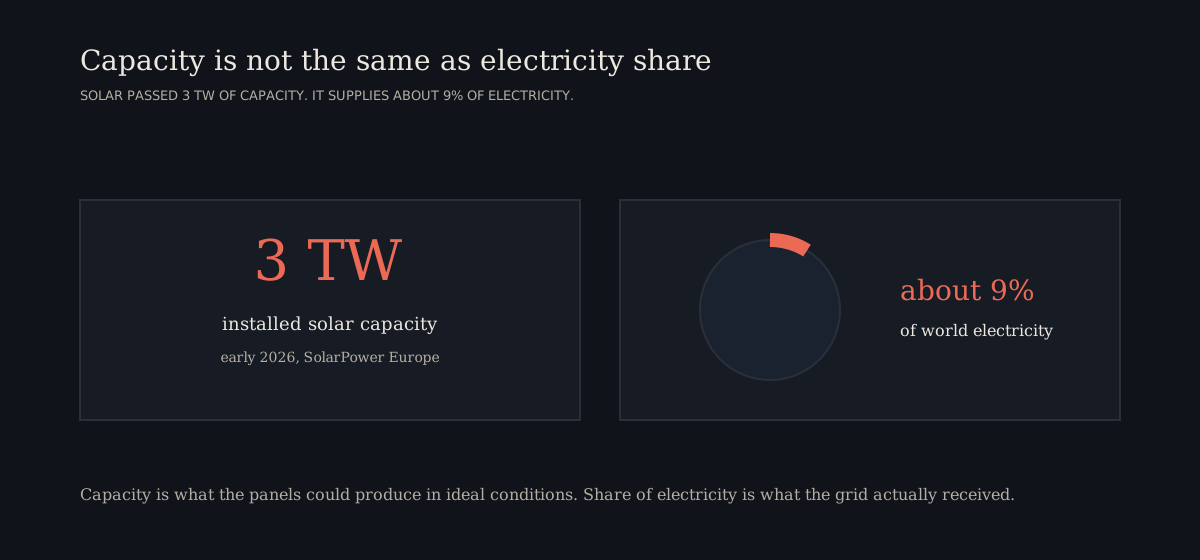
The two figures on the board
According to SolarPower Europe, solar panels worldwide passed three terawatts of installed capacity in early 2026, three times the total of four years before. The same source puts solar at about 9% of the world's electricity. Those are the figures on our home page.
Three terawatts is a large industrial fact. It means manufacturing, installation, and grid connection have all moved fast by the standards of energy infrastructure. A tripling in four years is not a rounding error. It is also a capacity figure. The sun is not available at full power all day, every day, so the energy actually delivered is lower than the nameplate total might suggest if you forgot about night and weather.
Nine percent of electricity is not nine percent of energy
Electricity is only part of world energy use. Fuels for heat and transport still make up a large share of the primary-energy total that sits behind the type number. Solar's 9% share of electricity is therefore a statement about the grid, not about all energy. How to read world energy numbers is the longer warning against mixing those accounts.
Electrifying more of heat and transport would make the electricity share more important for the type number, because more of the world's work would run through the grid. That shift is underway in some places and not in others. It should be measured as it happens, not assumed into the 9% figure.
What solar can and cannot do for the scale
A planet already intercepts far more sunlight than humanity uses. The long-run limit on solar at the surface is not that the star is too dim. It is land, materials, storage, and the grid. Those are real constraints, and this page will not invent a number for how tight they are. The point is simply that "the Sun is large enough" and "we can build as much as we want, wherever we want" are different claims.
Solar also cannot, by itself, reach Type II while it stays on a planet. Capturing a star's energy is about collectors that could see the light that misses the Earth. Surface solar is still one of the main ways a Type I climb could be powered, because Type I, on the convention we use, is about the energy available to a planet. That is a different job, and it is the job in front of us.
How to read the next update
When a later report raises the capacity figure or the electricity share, ask which one moved. Ask whether the share is of electricity or of primary energy. Ask whether the capacity is a world total or a regional one. A regional boom can be real and still leave the world share almost unchanged.
And keep the type number in its place. Fast solar growth can matter a lot for emissions, prices, and the electricity mix, and still leave humanity at about 0.73 on the scale. Both facts can be reported on the same site without forcing one to pose as the other. The current type reading is explained on Where humanity sits on the scale.
Common questions
Does three terawatts of solar mean the world now runs on three terawatts of solar power?
No. Three terawatts is installed capacity, the size of the fleet. Actual output, averaged over time, is lower because sunlight varies. The 9% figure is the more direct statement about electricity supplied.
Why does the home page list solar separately from the 0.73 type?
Because they answer different questions. The type is based on all primary energy. Solar capacity and electricity share tell you how one source is growing inside the mix.
Is 9% of electricity the same as 9% of the climb to Type I?
No. Type I is a power level, not a share of the current grid. A source can grow quickly inside electricity and still leave the world far below 10^16 watts of total use.