What fusion gain means
A laboratory can beat one ratio and still be far from electricity you can sell.
The ratio people quote
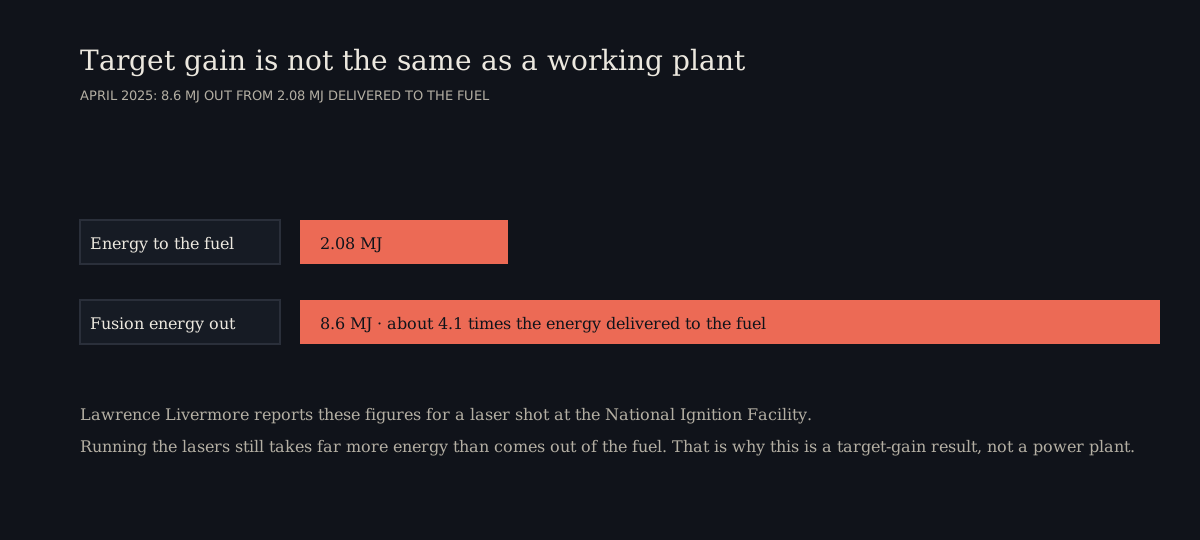
In a laser fusion experiment, a pulse of light squeezes a small capsule of fuel. If the fusion reactions release more energy than the lasers delivered to that capsule, the shot is said to have reached target gain above one. The first widely reported case of that, in 2022, produced 3.15 megajoules from 2.05 megajoules delivered to the fuel. In April 2025 a shot at the same US laboratory produced 8.6 megajoules from 2.08 megajoules, a target gain of about 4.1 times. Those figures, and the source at Lawrence Livermore, are the ones on our home page.
That is a genuine scientific milestone. For a long time, getting more energy out of the fuel than the light put into it was an open question. It is now a result that has been repeated and improved, at least in the target-gain sense.
What the ratio leaves out
Target gain does not count the energy it took to run the lasers. The machines that produce the pulse are not perfectly efficient. As the home page notes, running the lasers still takes far more energy than comes out of the fuel. A shot can therefore have a target gain above one and still be a net consumer of energy when you look at the whole facility.
There is a second gap, just as large. A power station has to do this over and over, turn the heat into electricity, and do it at a cost and a rate that the grid can use. A single capsule in a laboratory is not a power station. It is evidence that one physical step can go in the right direction.
Why the milestone still belongs on the scoreboard
If the only allowed news were "the type number moved," fusion would almost never appear. Laboratory shots do not add 19 trillion watts to the world total. They belong here for a different reason: a Type I or Type II energy system may need sources that are not limited by weather or by a one-time store of fuel in the ground. Fusion, if it can be made to work as a system, is one such source.
Keeping the milestone in view, with its limits attached, is better than either hype or silence. Hype treats 4.1 times target gain as if the grid had already changed. Silence pretends the experiment is irrelevant because the type number did not move. The honest middle is to report the ratio, name the missing terms (facility energy, repetition rate, conversion, cost), and wait for those terms to have published figures of their own.
How to read the next headline
When a later shot is announced, the useful questions are simple. What energy came out of the fuel, and what energy was delivered to it? Did the lab also publish the energy used to run the lasers? Was this a single shot or a repeated one? Has anyone published a design for turning the heat into electricity at a useful scale?
Until those last questions have answers you can cite, the result stays in the laboratory column. That is not a slight. Laboratories are where this work has to start. It is a category. For the wider energy context, see How to read world energy numbers and where humanity sits on the scale.
Common questions
Does a target gain of 4.1 mean fusion now produces four times more electricity than it consumes?
No. That ratio compares energy from the fuel with energy delivered to the fuel. It does not include the energy used to run the lasers, and it is not a measurement of electricity sent to a grid.
Why list fusion if it does not move the type number?
Because the type number is a present-tense score, and fusion gain is a condition for a later one. A laboratory result can be worth tracking without being counted as world energy use.
Are these the only fusion experiments that matter?
No. Other machines use magnetic fields rather than lasers, and they report progress in different units. This page focuses on the laser-target figures already cited on our home page, so we do not mix methods or invent a single league table.