Why reaching orbit still matters
Collectors that stay on a planet can never see the light that misses it. Getting machinery off the world is still expensive.
What we can actually quote
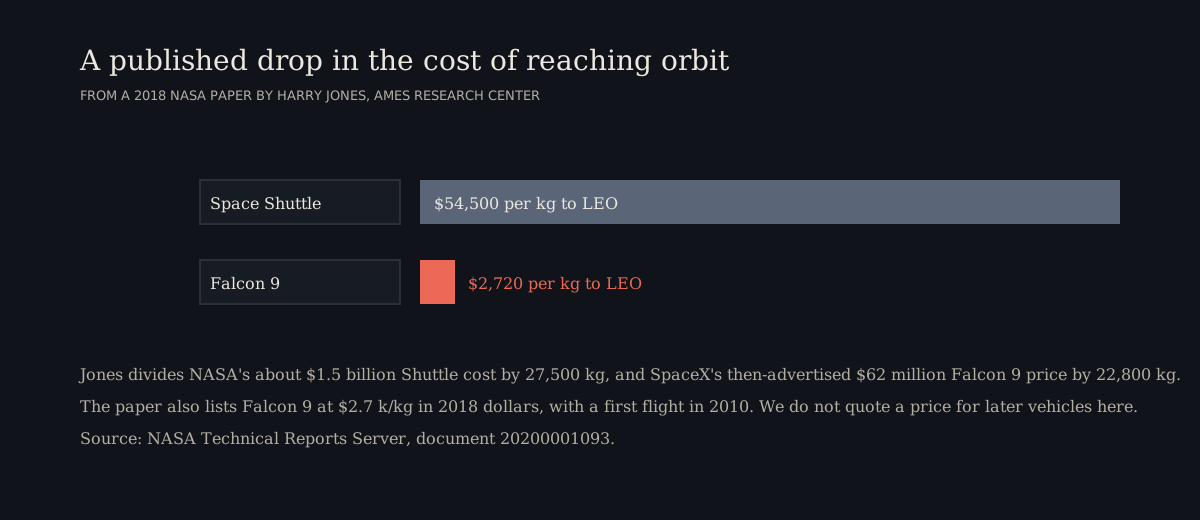
In a 2018 conference paper, later posted on the NASA Technical Reports Server, Harry Jones of NASA Ames put SpaceX's Falcon 9 at $2,720 per kilogram to low Earth orbit. He gets there by dividing the then-advertised $62 million launch price by a 22,800 kilogram payload. In a table in the same paper he lists Falcon 9 at $2.7 k/kg in 2018 dollars, with a first flight in 2010.
That is the figure on our home page, and that is the source. We will not treat it as a 2026 sticker price, and we will not invent a current price for later vehicles. Our World in Data also republishes a CSIS compilation of launch costs to low Earth orbit, which is a useful place to see the longer history.
The number is still a useful marker. It tells you that even after a large drop from Shuttle-era costs, a kilogram to orbit still cost thousands of dollars in the figure we can cite. Any plan that depends on lifting millions of tons will feel that, unless a later published price shows that it has changed.
Why orbit sits on an energy scoreboard
A Type II civilization, as Type 2 Civilization describes it, would collect energy that never hits a planet. That work happens in space. The collectors, the ships that service them, and the machines that assemble them have to get there, or be built there from material that got there earlier.
Launch cost is not the only barrier. It is the first one. If it costs thousands of dollars to lift a kilogram, you will not build a swarm from ground-made parts in any ordinary industrial sense. You will look for ways to use material already off the planet, and for ways to make each lifted kilogram do more work. Robotics is part of that second job. Robot Motion is about the machines. This page is about why the lift itself still matters.
Reuse, and what a flight does not prove
Reuse can, in principle, spread the cost of a vehicle over many flights. Whether it does, and by how much, is a question for published prices and flight rates, not for a single milestone.
SpaceX, Blue Origin, and other companies publish news about tests and flights. Those reports are worth reading. They are not a substitute for a price we can put on this page. Until a later commercial price is published in a source we can cite, the honest line is the Jones figure above.
What would move this figure
A published commercial price would move it. A sustained flight rate, with costs attached, would move it more than a single flight. In the other direction, a pause or a price that stays high would leave the 2018 figure looking less like history and more like a floor that has not yet been replaced.
None of those updates would move the type number by themselves. Launch is infrastructure for a later climb, not a substitute for world energy use. We keep it on the scoreboard so the energy story does not silently assume that space is already cheap. For the score itself, start with How we measure civilizations.
Common questions
Is $2,720 per kilogram the current price of reaching orbit?
No. It is the figure Harry Jones published in 2018, based on SpaceX's then-advertised Falcon 9 price and payload, with the rocket's first flight dated 2010. We do not quote a later vehicle's price here because we do not have a published figure to cite.
Why does launch belong on an energy site?
Because any plan to collect energy that misses the planet depends on putting machines in space, or on building them from material already there. The cost of the first step still shapes what is realistic.
Would cheaper launch automatically raise the Kardashev type?
No. The type is based on power used. Cheaper launch would make some later energy projects more plausible. It would not, by itself, change the 0.73 reading.