How we measure civilizations
A civilization can be ranked by the power it uses. That is a useful score, and a narrow one.
A score, not a verdict
This site exists to keep score. The score is the Kardashev type, a number based on how much power a civilization uses. Type 2 Civilization explains the goal the number is named for. We keep the figures, the sources, and the milestones that move them.
It is easy to treat the number as a grade, as if a higher type were a better civilization. That is not what the scale claims. Two societies could use the same power and live very different lives. The score does not measure justice, peace, or wisdom. It measures energy use, because energy use is something you can add up.
That narrowness is a feature. If you want one number that still makes sense for a society that may not share our languages or our politics, you need a quantity that physics can see. Power is such a quantity. Heat, light, computation, and industry all leave an energy trail.
From a yearly total to a type
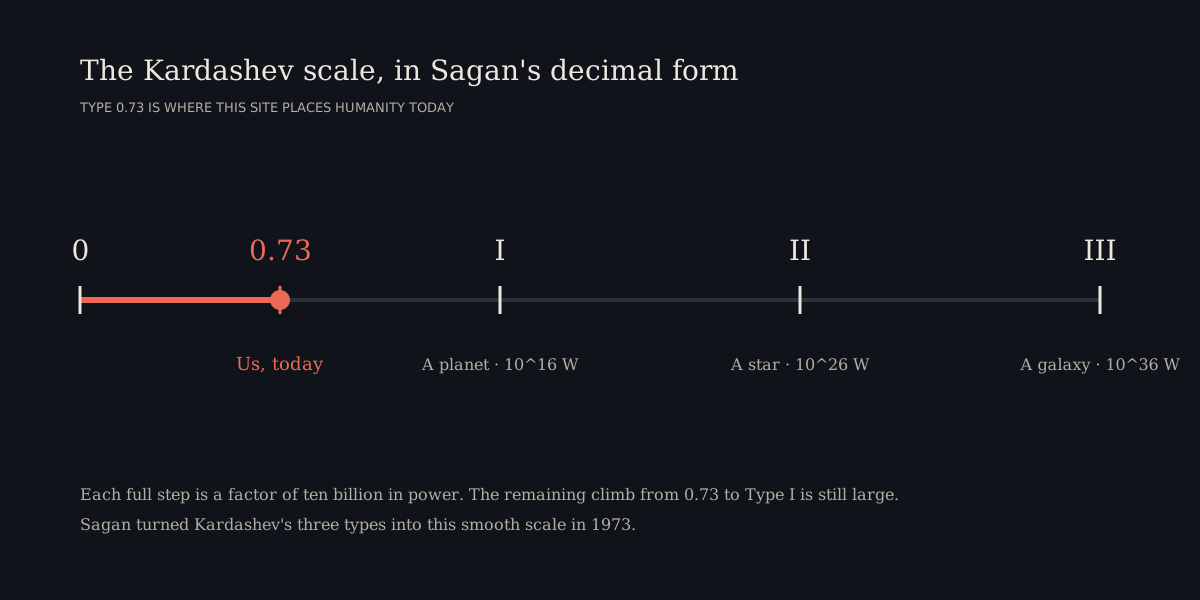
The path from a published energy report to a type number has a few steps, and each one should stay visible. You start with a yearly energy total, usually given in exajoules. You convert that total into an average power in watts by dividing by the number of seconds in a year. You then put the watts into Sagan's formula, K = (log10(P) - 6) / 10. How the Kardashev scale works shows the arithmetic. How to read world energy numbers shows how to treat the yearly total with care.
For 2025, the Energy Institute's Statistical Review of World Energy put world energy use at 600 exajoules, up 1.7% in a year. That is about 19 trillion watts, or a type of about 0.73. Those are the figures on our home page. If a later review revises the total, the type should be recalculated, not defended as a brand.
What belongs on the scoreboard
A good scoreboard shows more than the headline number. World energy use tells you where the type sits today. Other figures tell you whether the climb, if it comes, has anything under it. Fusion gain tells you whether a laboratory can get more energy out of a fuel capsule than the lasers delivered to it. Installed solar capacity tells you how fast one already-working source is being built. The cost of reaching orbit tells you how expensive it is to put machinery beyond the atmosphere, which matters if you ever want collectors that are not stuck on a planet.
Each of those figures can be misunderstood if you read it as the type number by another name. A record fusion shot does not move 0.73. A terawatt of solar capacity does not, by itself, mean Type I is near. The right way to read them is as conditions. They show whether the tools for a later climb are getting more real, or not. The pages on fusion gain, solar capacity, and reaching orbit are written in that spirit.
What we will not invent
A progress report is only as good as its sources. This site will not invent a more precise type number than the energy data can support. It will not treat a laboratory result as a power station, or a nameplate capacity figure as energy already delivered. It will not invent a launch price when no price has been published.
When a figure is a baseline from an earlier year, it will be labeled as such. When a milestone has no public cost, the page will say so. The aim is a score you can check, not a story that has to stay exciting. If you want the wider argument for why the score is worth keeping at all, start with What is a Type II civilization?.
Common questions
Why energy, rather than information or population?
Energy is a single quantity you can add up, and every physical process has an energy cost. Information and population matter, but they do not replace the power budget. A larger, more computationally busy civilization still has to find the watts.
Who decides what the official type is?
Nobody. The type is a calculated figure. Different energy totals, or a different convention for the Type I landmark, will move it. We show our sources so you can repeat the calculation.
Does the score include only peaceful energy use?
No. A world energy total includes whatever the source counts, without a moral filter. That is one more reason not to treat the type as a grade.